
Ceremonial vs Culinary Grade Matcha: How to Choose
Walk into any health food shop or scroll through an online tea retailer and you will quickly encounter two categories: ceremonial grade and culinary grade matcha. The price difference can be substantial — sometimes three or four times as much for ceremonial — and it is not always clear what you are actually paying for. This guide breaks down the real differences so you can make the right choice for your needs and budget.
Where the Difference Begins: The Leaf
Both ceremonial and culinary grade matcha start as tencha leaves from the Camellia sinensis plant, shade-grown for at least 20 days before harvest to boost L-theanine and chlorophyll content. The divergence begins at harvest time. Ceremonial grade uses the youngest, most tender leaves from the very tips of the plant — the first flush of the spring harvest, known as ichibancha. These leaves are the richest in L-theanine, the smoothest in flavour, and the most vibrant in colour.
Culinary grade matcha typically uses leaves from later harvests, or slightly older, more mature leaves from the same plant. These leaves have higher catechin content (contributing to bitterness) and lower L-theanine content (which provides sweetness and umami). The resulting powder is darker, sometimes yellower, and more astringent.
Colour, Texture, and Aroma
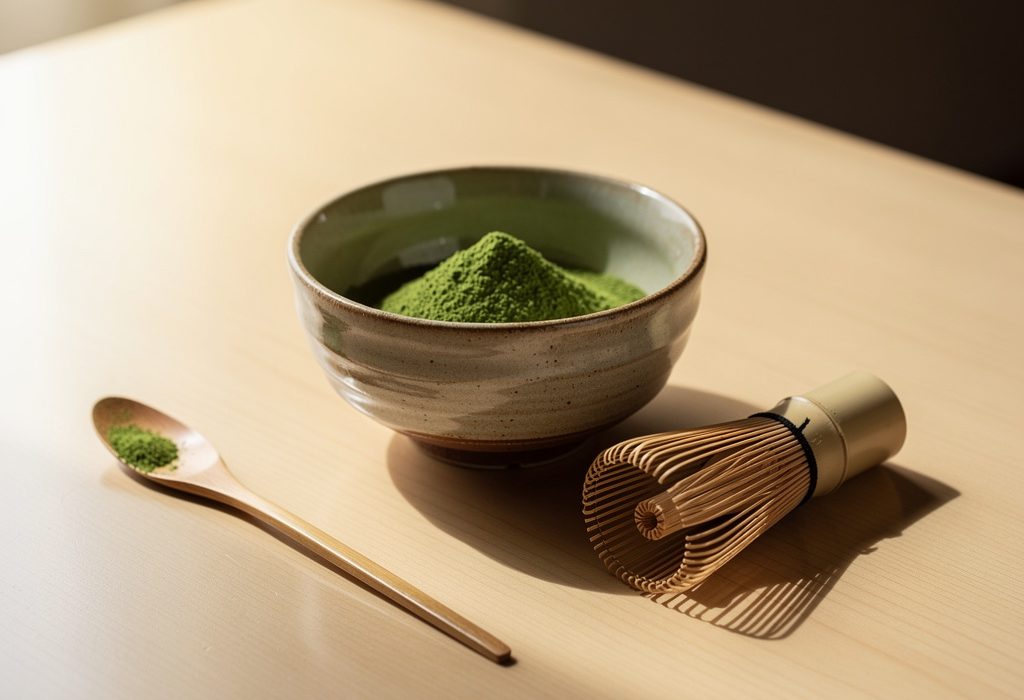
The most immediate way to distinguish grades is by sight. Open a tin of high-quality ceremonial matcha and you will see a powder that is a vivid, almost electric green — the colour of new spring leaves. Culinary grade tends towards a more muted, darker or olive-toned green. This colour difference is primarily due to chlorophyll content: the shading process concentrates chlorophyll dramatically, and first-harvest ceremonial leaves accumulate the most.
Texture is another indicator. The finest ceremonial grade matcha is stone-ground to a particle size of 5–10 microns — so fine it feels almost silky between your fingers and dissolves readily in water. Lower grades may feel slightly coarser, and will sometimes show a tendency to clump more readily.
Aroma should be fresh, grassy, and slightly sweet — reminiscent of fresh green vegetables or a Japanese garden after rain. If the matcha smells flat, dusty, or faintly stale, it has either been stored poorly or is of lower quality.
Taste: The Most Important Difference
This is where ceremonial grade earns its premium. Whisked with hot water alone — the traditional preparation — ceremonial matcha reveals a complex flavour profile: smooth, rich umami at the front, a natural sweetness from L-theanine, a gentle grassy note, and a clean, lingering finish with minimal bitterness. It requires no sweetener and no milk to be enjoyable.
Culinary grade matcha whisked in water alone tends to taste noticeably more bitter and astringent. This is not a flaw per se — it is simply a characteristic of the leaf type and harvest timing. When blended into a latte with oat milk and a touch of honey, or baked into matcha cookies where other flavours contribute sweetness and richness, culinary grade performs excellently and provides good colour and matcha flavour at a more accessible price point.
Which Grade for Which Use?
The decision comes down to application. For traditional preparation — whisked in a bowl with water, in the spirit of the Japanese tea ceremony — ceremonial grade is the right choice. The entire experience depends on the matcha’s inherent sweetness and smoothness; culinary grade will be unpleasantly bitter without milk or sugar.
For matcha lattes, the answer is more nuanced. A high-quality ceremonial grade will produce a noticeably more flavourful and complex latte, and many enthusiasts feel it is worth the premium even in milk-based drinks. However, a good culinary grade specifically intended for milk-based preparation can produce excellent results at lower cost, particularly when paired with a naturally sweet milk like oat.
For cooking and baking — matcha mochi, matcha tiramisu, matcha cookies, smoothies — culinary grade is the practical and economical choice. The strong flavours of butter, chocolate, and sugar in baked goods mean the subtle nuances of ceremonial grade are largely lost. Save the ceremonial tin for drinking.
A Note on Misleading Labelling
There is no universal regulated standard for “ceremonial grade” — any producer can technically apply the term to any product. The best protection is to buy from producers with transparent sourcing (specifically: named growing regions in Japan, ideally Uji or Nishio), who can share harvest information, and whose colour and aroma match the characteristics above. A dramatically low price point for something labelled “ceremonial” is almost always a red flag.
At True Matcha, our ceremonial grade is sourced directly from Uji, Kyoto — the historic heartland of Japanese matcha — stone-ground to order and shipped fresh. Whether you are preparing your first traditional bowl or building a daily latte ritual, we have the right grade for every cup.