The Japanese Tea Ceremony: A Timeless Ritual of Matcha and Mindfulness

The Japanese Tea Ceremony: A Timeless Ritual of Matcha and Mindfulness
In a world that rarely slows down, the traditional Japanese tea ceremony — known as chado or “the way of tea” — offers something increasingly rare: a moment of complete, intentional presence. At its heart lies matcha, the finely ground ceremonial grade green tea powder that has been central to this ritual for nearly five centuries. Whether you are new to matcha or a devoted enthusiast, understanding the tea ceremony deepens every cup you make at home.
The History and Philosophy of Chado
The Japanese tea ceremony traces its formal origins to the 15th century, when Buddhist monk Murata Juko began fusing Zen philosophy with the act of drinking tea. It was later refined by the legendary tea master Sen no Rikyu in the 16th century, who distilled the practice into four timeless principles: wa (harmony), kei (respect), sei (purity), and jaku (tranquillity). These principles were not merely aesthetic ideals — they shaped every gesture, every tool, and every grain of matcha used in the ceremony.
Chado arrived in Japan alongside Zen Buddhism, brought by monks who had studied in China. The practice of grinding green tea leaves into a fine powder and whisking them with hot water — the very process that defines matcha — was already established in Song Dynasty China. Japanese monks adopted and elevated it into a spiritual discipline, one in which the act of preparing and serving tea became a path toward enlightenment. Today, the tea ceremony endures as one of Japan’s most cherished cultural traditions, practised in dedicated tea rooms (chashitsu) and studied for years by devoted students of the way.
The Essential Tools of the Tea Ceremony
What makes the Japanese tea ceremony so captivating is the extraordinary care given to every object involved. Each tool is chosen with intention, crafted by skilled artisans, and handled with deep reverence. Understanding these tools gives you a richer appreciation for the matcha you enjoy every day:
- Chawan (tea bowl) — The most personal of all ceremony tools, the chawan is a wide, handcrafted ceramic bowl sized to cradle in both hands. Its irregular, often asymmetrical form reflects the wabi-sabi aesthetic — the beauty found in imperfection. A single chawan may take a lifetime to appreciate fully.
- Chasen (bamboo whisk) — Carved from a single piece of bamboo, the chasen’s delicate tines are used to whisk ceremonial grade matcha into a smooth, frothy suspension. A quality chasen may have 80 to 120 tines and requires careful maintenance to preserve its shape.
- Chashaku (bamboo scoop) — This elegant, curved scoop is used to measure matcha powder from the natsume (tea caddy) into the bowl. Traditionally carved from a single piece of bamboo or ivory, each chashaku is a small work of art.
- Natsume (tea caddy) — The lacquered wooden container that holds the ceremonial grade matcha powder. Often decorated with seasonal motifs, the natsume is treated as one of the ceremony’s most precious objects.
- Fukusa (silk cloth) — A folded silk cloth used to ritually cleanse each tool before use, transforming what could be a practical act into a meditative one.
How a Traditional Tea Ceremony Unfolds
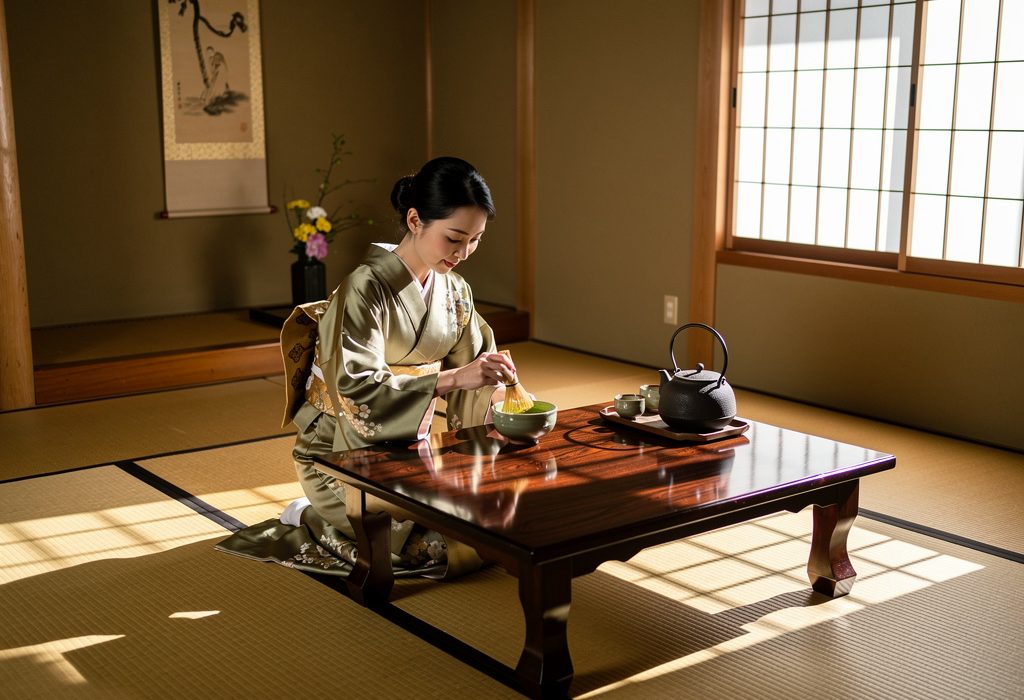
A formal tea ceremony can last up to four hours, beginning with a kaiseki (light meal) and culminating in the preparation and sharing of matcha. In its most common form, the host prepares a bowl of koicha (thick tea) using a higher ratio of best matcha powder to water, then follows with a bowl of usucha (thin tea) — the lighter, frothy style most familiar to matcha lovers today.
Every movement in the ceremony is choreographed and practised over years: the precise angle of the water ladle, the three-and-a-half turns of the chasen when whisking, the deliberate rotation of the chawan before drinking so that its most beautiful face is not touched by the lips. The effect is not one of rigid formality, but of deep calm. Guests arrive, leave the chaos of the world at the garden gate, and enter a space where nothing matters except this bowl, this moment, and the person who made it for you.
The tea used in ceremony is always the finest ceremonial grade matcha — a category defined by its vibrant green colour, silky texture, and umami-rich flavour. Unlike culinary grade matcha (which is excellent for lattes and baking), ceremonial grade matcha is shade-grown for several weeks before harvest, causing the tea plant to produce higher concentrations of chlorophyll, L-theanine, and amino acids. The result is a tea of remarkable depth that needs nothing added — no milk, no sweetener — just 70°C water and a skilled hand.
Bringing the Spirit of Chado Into Your Daily Life
You do not need a traditional tea room to experience the essence of the Japanese tea ceremony. The principles of chado — harmony, respect, purity, and tranquillity — translate beautifully into an everyday matcha ritual. Begin by choosing high-quality ceremonial grade matcha: the colour should be a vivid, almost electric green, and the aroma should be fresh, grassy, and sweet. Sift your matcha powder to remove lumps, add a small amount of water heated to around 70–75°C, and whisk in a W-shape until a light foam forms on the surface.
Then — and this is the part that matters most — pause before you drink. Hold the bowl with both hands. Notice its weight, its warmth, its texture. Take a moment to appreciate everything that brought this matcha to you: the farmers who shade-grown the bushes in Uji or Nishio, the artisans who stone-ground the leaves, the tradition that has kept this practice alive for five centuries. That moment of gratitude is, in its simplest form, what chado is all about.
If you are ready to begin your own daily matcha ritual with the finest ceremonial grade matcha available, true-matcha.com sources premium matcha direct from trusted Japanese farms. Every tin is a small invitation to slow down, be present, and experience the timeless way of tea.