The Japanese Tea Ceremony: A Living Tradition of Matcha and Mindfulness

The Japanese Tea Ceremony: A Living Tradition of Matcha and Mindfulness
In a world of constant noise and distraction, the Japanese tea ceremony — known as chado or chanoyu — offers something increasingly rare: a dedicated space for presence, beauty, and connection. At its heart is ceremonial grade matcha, whisked into a vibrant emerald bowl and shared with quiet reverence. Understanding this ancient tradition transforms the way we experience every cup of matcha we make at home.
What Is the Japanese Tea Ceremony?
The tea ceremony is far more than a method of preparing matcha — it is a complete philosophy of living. The practice is built on four foundational principles articulated by the legendary tea master Sen no Rikyu in the 16th century: wa (harmony), kei (respect), sei (purity), and jaku (tranquility). Together, these values guide every gesture, every arrangement, and every breath within the tea room.
Historically, chado evolved from Chinese tea-drinking customs introduced to Japan by Buddhist monks during the 9th century. It was gradually refined over centuries, moving from the elaborate gatherings of samurai culture into a disciplined spiritual practice. By the Muromachi period, the tea ceremony had become a cornerstone of Japanese aesthetics — influencing architecture, garden design, ceramics, calligraphy, and flower arranging all at once.
Today, millions of people study chado in Japan and around the world, not simply to learn how to make matcha at home, but to cultivate a deeper attention to the present moment.
The Essential Tools of Chado
Every object in the tea ceremony carries meaning, and each is chosen with meticulous care. The chawan (tea bowl) is perhaps the most treasured piece — often a handcrafted ceramic vessel whose irregular glaze and tactile surface are meant to be appreciated with both hands. The rustic, intentionally imperfect beauty of a fine chawan embodies the Japanese aesthetic of wabi-sabi: finding grace in imperfection and impermanence.
The chasen (bamboo whisk) is a marvel of craftsmanship, carved from a single piece of bamboo into dozens of fine tines. A quality chasen is essential for preparing ceremonial grade matcha properly — it aerates the powder and creates the smooth, frothy consistency that distinguishes a well-made bowl of tea. The chashaku (bamboo scoop) measures the matcha with precision, while the natsume (lacquered caddy) stores the precious powder, protected from moisture and light.
Even the water used in ceremony is considered carefully. Traditionally drawn from a mountain spring, it should be heated to around 70–80°C — hot enough to dissolve the best matcha powder fully, but cool enough to preserve its delicate grassy sweetness and avoid bitterness.
A Ceremony in Motion: The Experience of Chanoyu
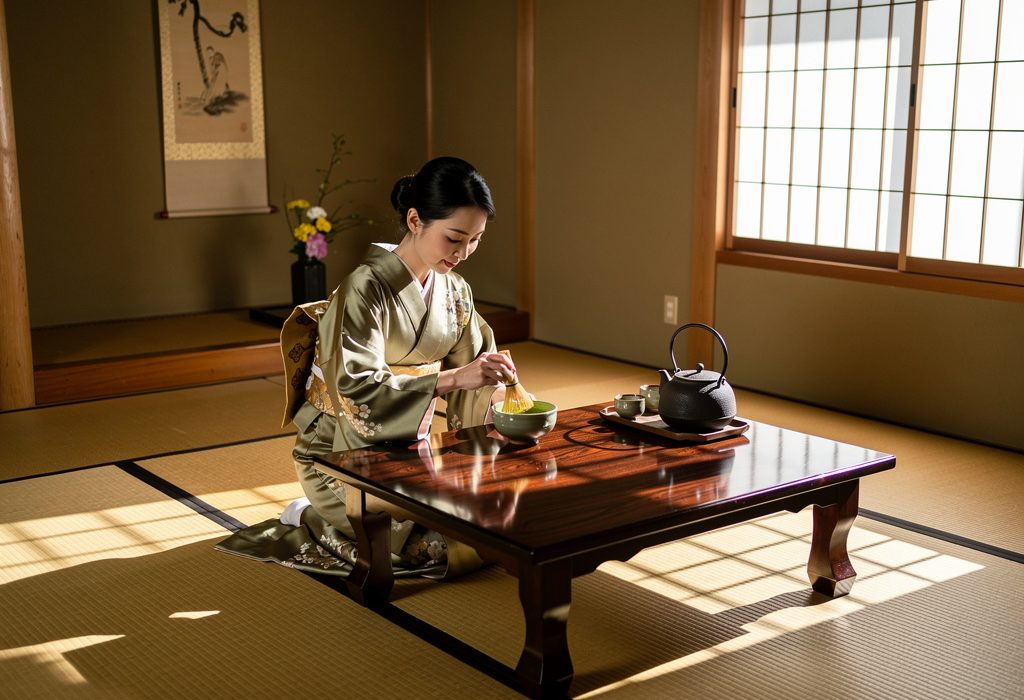
Entering a traditional tea room, guests pass through a small, low doorway called the nijiriguchi — a feature intentionally designed so that all must bow to enter, leaving status and ego outside. The tea room itself is spare and serene: tatami mats, a hanging scroll, a simple flower arrangement, and the gentle sound of water heating in an iron kettle.
The host, having trained for years in the precise choreography of the ceremony, prepares the tea with unhurried, deliberate movements. Each action — folding the cloth, rinsing the bowl, scooping the matcha — is performed as a form of moving meditation. For the guest, observing this process becomes its own contemplative practice.
The matcha itself is prepared in one of two styles: usucha (thin tea), a lighter, frothier preparation using about 1.5 to 2 grams of ceremonial grade matcha per 70ml of water, or koicha (thick tea), a deeply concentrated preparation that requires the finest, most expensive matcha powder and a kneading rather than whisking motion. Koicha has a rich, almost syrupy texture and is typically shared from a single bowl passed among guests — a powerful symbol of unity.
Bringing the Spirit of Chado Into Daily Life
You do not need a tea room or years of formal training to carry the essence of chado into your mornings. The spirit of the practice lives in the quality of attention you bring to the simple act of making tea. Choosing the best matcha powder you can find — a stone-ground, shade-grown ceremonial grade matcha from Uji or Nishio — is the first step. The difference in flavour, colour, and aroma between a fine ceremonial matcha and a generic culinary grade powder is immediately apparent.
Set aside your phone. Heat your water to the right temperature. Sift your matcha into a warmed bowl. Whisk with intention, using a quick “W” or “M” motion until a fine foam rises. Then pause before you drink — appreciate the colour, the aroma, the steam. This single minute of mindfulness, practised daily, is the heart of chado distilled for modern life.
The Japanese tea ceremony reminds us that extraordinary experience is available in the ordinary — in a bowl, a whisk, and a moment of stillness.
Ready to begin your own matcha ritual? Explore our collection of ceremonial grade matcha, hand-selected from Japan’s finest growing regions, at true-matcha.com. Every order comes with preparation guidance so your first bowl — and every bowl after — is something to savour.